On page 1, Indy complains to Marcus that Sophie thinks the lost
continent of Atlantis is as real as Hoboken.
Hoboken is a small city in New Jersey across the Hudson River from
New York City.
As Indy wonders what the Nazis want with the Jastro relics,
Marcus adds, "Why, Indy? They're not worth much. And surely Adolph
isn't after academic laurels!" "Adolph", of course, refers to Adolf
Hitler, evil ruler of
the German state under the Nazi Party from 1933-1945.
Indy remarks that Sophie expounds the theory that the continents
drifted apart from one single continent to form the landmasses we see now, but he
thinks it's nonsense. Speculation of continental drift having taken
place over eons is known to have begun as early as the late 16th
Century, more fully developed by geologist Alfred Wegener in 1915,
and widely accepted at the end of the 1960s with the establishment
of plate tectonic theory within Earth sciences. Indy is off base
here to think it's nonsense!
On page 3, Indy tells Jerry to deliver some cables to
Western Union.
On page 4, Marcus reminds Indy that
Duke University is
talking of testing the claims of psychics and Indy skeptically
responds, "Et tu, Marcus?". Actually, Duke was already
performing parapsychological research at this time, under the
founder of the parapsychology lab there, J.B. Rhine, from 1930-1965.
Et tu is Latin for "and you".
Indy recovers from his gunshot wound at Midtown General Hospital.
This is a fictitious hospital...often used as
a New York hospital in Marvel Comics!
When Sophie clocks the murderous Beth on the head with her purse,
Beth mutters, "Verdammt..." This is German for "Damn..."
Sophie checks the identification card she finds in Beth's purse
and sees that "Beth" is actually Fraulein Jutta
Schwarzkopf.
Fraulein is German for "Miss".
After the
fraulein's attempt on Indy's life, Sophie wonders how he
became so popular in Berlin.
Berlin is
the capital city of Germany.
On page 6, from Long Island, Indy and Sophie
plan to cross the Atlantic to Iceland in short hops by plane, "like
the Lindberghs did five years ago!" Presumably, this refers to the
trip taken in December 1935 by American aviator Charles Lindbergh
and his wife and 3-year old son, Jon, from the U.S. to England by
boat and plane. The trip was made in secret under assumed identities
in order to escape the public attention his family was receiving
after the kidnapping and murder of the couple's first son and the
trial that had followed. This would have been "four years ago", not
five, as stated by Indy.
Long Island is a large island that makes up a large part of the New
York City metropolitan area.
In the video game, Indy and Sophie seem to make a
straight trip to Iceland instead.
In the comic, Sophie's family rents a small two-seater
seaplane for she and Indy to take across the Atlantic. Indy himself
is the pilot! I guess he learned to fly after all of his close calls
with death aboard small planes in his adventures (see
"Attack of the Hawkmen",
The Seven Veils,
The Temple of Doom,
"22-Karat Doom",
"Gateway to Infinity",
The Great Circle, and
The Last Crusade).
On page 8, in Greenland, Indy tells Sophie they'll radio
Reykjavík for land transport.
Reykjavík is
the capital of Iceland.
In Greenland, some Eskimos bring supplies and gifts to Indy and
Sophie's plane.
Eskimos (Inuit and Yupik) are the indigenous peoples
of the northern circumpolar region of the globe: Siberia, Alaska,
Canada, and Greenland. The "Eskimo" term has come to be viewed as a
slur, as it is believed to be related to the Cree word askâwa,
meaning "raw meat", suggesting an eater of raw meat, or a barbarian.
The generally-preferred term is "Inuit", though other cultural
descriptors may sometimes be used.
|
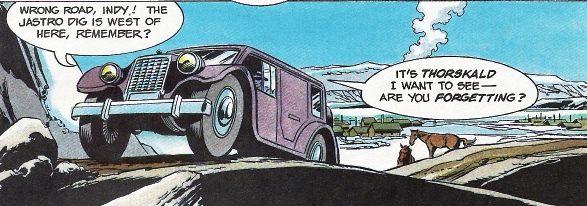
The car Indy and Sophie take to
the Jastro dig site as seen here is very odd looking...I'm
assuming it's not a real world model of vehicle. In the
novelization, Indy and Sophie rent a Ford Model T. |
 |
In the comic, Indy and Sophie continue their journey from Iceland
to the other locations Jastro had originally visited after Iceland:
Copenhagen,
Rotterdam,
Paris,
Geneva, and
Lisbon,
before arriving in the Azores. In the game they head straight to
Tikal from Iceland. In the novelization, they head to the Azores
first.
Indy and Sophia pass over
Horta in their
plane to land in a more remote bay of the island of Faial in the
Azores.
The character of Rodrigo here is the stand-in for Pearce, seen
the game.
When Indy and Sophie find Jastro's old hidden stash of Atlantean
relics in a cave on Faial, Indy remarks, "Two more horned idols! And
Henry Ford got credit for mass production! Ha!"
Henry Ford (1863-1947) was the founder of
Ford Motor Company,
who helped perfect the assembly line manufacturing process for
automobiles.
On page 15, the antiques and
memorabilia store Indy and Sophie stop at in Guatemala has a sign in
the window announcing they speak English. Other languages on the
sign include German, French, Italian, and Yiddish.
Dr. Sternhart guides Indy and Sophie to an ancient city in the
jungle. He comments that it looks Mayan but may be even older. The
Maya civilization was a Mesoamerican civilization that existed from
about 2000 BC to 1697 AD.
On page 17, Marcus receives a telegram for Indy asking him to
meet a Dr. Uribe in
Cadiz, Spain.
On page 17, señor is Spanish for "sir".
On page 18, padre mio is Spanish for "my father".
Indy and Sophie receive a telegram via the consulate in Guatemala
from Marcus, telling them to meet him in Leningrad.
Leningrad is now known as
Saint Petersburg,
the second largest city in Russia.
On page 22, Sophie complains that they've added a stop at
Helsinki as
well, before arriving in Leningrad.
In panel 2 of page 22, the banner image seen hanging on a
building in Leningrad is a protarait of Vladimir Lenin (1870-1924), the communist
founder of the Soviet Union in 1922 after the dissolution of the
Russian Empire in 1917.
Professor Radichenko hugs Indy, calling him Tovarich,
which is Russian for "comrade".
On page 24,
Professor Radichenko tells Sophie that it is useless to call the
Leningrad police to stop Kerner as he flees with the lost Plato
manuscript because Comrade Stalin is paranoid about Der Fuerher
and turns a blind eye to German misdeeds. Joseph Stalin was the
totalitarian leader of the Soviet Union from the mid-1920s through
1952. Der Fuerher, of course, is Adolf Hitler, leader of
Germany at the time. Whether Stalin was actually paranoid about
Hitler's intentions at the time is unclear in history, but the two
nations would go on to sign a nonaggression pact against each other
in August 1939, which Stalin held to until Germany broke the pact by
invading Russia in 1941.
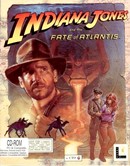 |
Indiana Jones
The Fate of Atlantis
Video game
Story by Hal Barwood & Noah
Falstein
Developed and published by LucasArts
1992
|
Characters appearing or mentioned in the computer game,
not in the comic book adaptation
Dr. Bjorn Heimdall (dies in the game)
Professor Felipe Costa
Pearce
(mentioned only)
Sprague (mentioned only)
Alain Trottier
Omar al-Jabbar
Didja Notice?
Here in the computer game, Indy and Sophie meet
Dr. Bjorn Heimdall working in the Jastro dig site. In the comic
book, no one is there, and Indy finds the frozen body of
Thorskald instead.
Heimdall tells Indy and Sophia they may want to visit Charles
Sternhart in Tikal.
Tikal is an ancient ruin in Guatemala.
Indy encounters a giant rodent in the Guatemalan jungle that he
herds into the path of a giant anaconda to distract the snake. The
rodent is most likely meant to be a capybara, though both capybaras
and anacondas are native to South America, not Central America.
When Indy spies a parrot in a tree, he says, "Polly want a
cracker?" This popular phrase in use with parrots dates back to a
cartoon published in 1848 and also became part of an advertising
slogan for Nabisco saltine crackers in 1876.
In a rather campy moment, Indy says to the
parrot, "Me and you." and the parrot responds, "And Tyler, too!"
This is a modification of "Tippecanoe and Tyler Too", a campaign
song for presidential candidate John Tyler in 1840.
After his exchange with the parrot, Indy says, "Bye bye
birdy." This would seem to be a reference to the eponymous 1960
Broadway musical stage show, which Indy would not be aware of in
1939!
The British Sternhart remarks that the name "Indiana" "Sounds
like the name of one of your states...or-or possibly a cat," and
Sophia corrects him, "Actually, it was the name of a dog." Indiana
gave himself the nickname (to differentiate himself from his father,
both of whom are first-named "Henry") based on his affection for the
family dog named Indiana. Indy will much later have a cat named
Henry, as seen in a few of the Old Indy bookends of The Young
Indiana Jones Chronicles TV episodes.
Costa believes that the Azores are the remnants of lost Atlantis.
This is an actual theory by some researchers of the Atlantean
legend.
Returning to Barnett College with Sophia to search for the Pearce
Collection there, Indy reads a number of postings pinned to a
bulletin board:
- someone selling a Woodstock typewriter.
This refers to one of various models of vintage typewriters made
by the Woodstock Typewriter Company in Chicago, IL, which
existed from 1907-1950.
- a movie tonight, The Thirty-Nine Steps. The
39 Steps is a 1935 classic spy thriller film directed by
Alfred Hitchcock, based on a novel by John Buchan.
- "Where have you gone, Joe DeMaggio?" This refers to a
line in the 1968 Simon & Garfunkel song "Mrs. Robinson".
Joe DeMaggio (1914-1999) was a Major League Baseball player for
the New York Yankees, considered one of the best players ever.
- "Will trade K&E sliderule for Fada radio". K&E (Keuffel
and Esser) was an American drafting instrument company from
1867-1987. It was particularly known for its sliderules.
At the Barnett library, Indy looks at a tipped over bookcase and
declares he believes it is part of the Ashkenazy Collection. This
must refer to books about Ashkenazi Jews, a subgroup of the Jewish
diaspora in the Middle Ages, who migrated to Poland in the 14th Century.
While speculating that Atlantis might have been in the
Mediterranean, Sophie says that Nur-Ab-Sal once told her that he was
from the middle of the world and that's what "Mediterranean" means.
"Mediterranean" comes from the Latin
mediterraneus (from medius "middle" and terra
"land").
Sophie remarks that she bought an old stone with a hole through
it from either Alain Trottier in
Monte Carlo
or Omar al-Jabbar in Algiers. Algiers is the capital city of Algeria
on the Mediterranean.
 |
Notes from the computer
game novelization by Dale Dassel
(pages 32-143 roughly
cover the events of
Indiana Jones and the Fate of
Atlantis #2) |
Summary of this portion of the
novelization
Iceland: After a flight via the historic
Yankee Clipper, Indy and Sophia arrive at the Jastro dig site, a
remote archaeological outpost. They encounter Björn Heimdall, a
reclusive archaeologist, and learn about orichalcum, a mysterious
Atlantean metal. A volcanic dust storm and a Nazi car chase force
them to flee, barely escaping with their lives.
Azores Islands: The duo travels to meet
Filipe Costa, a retired professor and collector of Atlantean relics.
Sophia trades an artifact for information, learning that Plato’s
lost dialogue, the Hermocrates, is in the Ashkenazy collection at
Barnett College—Indy’s home institution.
Germany: Meanwhile, Kerner delivers a
stolen Atlantean idol and orichalcum beads to Nazi scientists, who
discover the metal’s immense energy potential. The Nazis plan to use
orichalcum for advanced weaponry, escalating the stakes of Indy and
Sophia’s quest.
Tikal, Guatemala: Guided by Sophia’s
psychic vision, they trek through the jungle to a hidden pyramid.
With help from British archaeologist Charles Sternhart, they
discover the tomb of an Atlantean king and retrieve a keystone
artifact. Sternhart betrays them, but Indy and Sophia escape,
narrowly avoiding deadly traps and Nazi pursuers.
Barnett College, New York: Back home,
Indy and Sophia, aided by Marcus Brody and student Kathleen Marc,
search for Plato’s lost dialogue in the college archives. After much
effort, they receive the Hermocrates manuscript, which contains
clues to Atlantis’s location. Indy and Sophia realize that the true location
of Atlantis may be in the Mediterranean, not the Atlantic. Their
journey is far from over, as they must continue to decipher clues
and stay ahead of their adversaries to prevent the misuse of
Atlantean power.
Characters appearing or mentioned in this novel, not in
the video game
Barnett College janitor
Imperial Theater ushers
Henry Jones, Sr. (mentioned only)
Marion Ravenwood
(mentioned only)
Karl Sankt
Torsten Fleischer
Mercy
(mentioned only)
Conchita Costa
Clipper mooring crew
Clipper stewardesses
Clipper porters
Clipper passengers
Nikolaus Riehl
Juan
Sylvanus Morley
(mentioned only)
Kathleen Marc
Algerian boy
souk shopkeepers
Didja Know?
This book is a fan-written novelization of the game and comic book
and was
released online for free from 2010-2013. This piece
by Dale Dassel is generally held in high regard for its quality
of writing and research.
Didja Notice?
In the novelization, Indy and Sophia take off for Iceland on a
Pan American Airlines Yankee Clipper flight from
Port Washington,
New York. Pan American Airways was an American airline from
1927-1991. The Yankee Clipper NC18603 was an American Boeing 314
Clipper flying boat owned by Pan Am, that flew from America to
Europe from May 20, 1939 to February 22, 1943. Sophie comments that
they are on the first Yankee Clipper flight to carry passengers (as
opposed to just mail and cargo), but that was in July, not June as
she remarks on the month on page 33.
When Sophie complains about having to wait for their flight to
board and take off on page 33, Indy jokes, "Now boarding flight 138,
non-stop from New York to Atlantis." Besides the obvious joke of a
flight to Atlantis made by Indy, there is an in-joke by the writer
in that "138" is a frequent shortened reference to George Lucas'
first movie, 1971's THX-1138, often made in Lucas' later
films.
On page 33, Sophie remarks on Indy wearing his jacket in June.
Both the game and comic book present the story as taking place in
May.
Page 34 reveals that Indy has tenure at Barnett College.
The Clipper is said to get its thrust from four Wright Twin
Cyclone radial engines. This is correct. Wright Aeronautical was an
American aircraft manufacturer from 1919–1929.
Page 35 states the Clipper flight will take Indy and Sophie to the
tropical Azores Islands, where a connecting flight would take them
north to Iceland, on the rim of the Arctic Circle. The Yankee
Clipper did typically make a stop at the
Azores. In the
video game and comic book, Indy and Sophie visit the Azores
after their visit to Iceland.
CHAPTER 3: FIRE AND ICE
The Vatnajökull glacier mentioned on page 37 is an actual glacier
in Iceland.
In
Reykjavík, Indy and Sophie rent an old 1924
Ford Tin Lizzie to
drive to the site of the Jastro dig. "Tin Lizzie" is an affectionate
nickname that has been applied to the Model T Ford since 1922. On
page 45, "Flivver" is another nickname for the Model T.
Mount Hekla looms over the Jastro site. Mount Hekla is the
largest volcano in Iceland, a land of many volcanoes.
The entrance of the tunnel dig is framed by a pair of thick stone
pillars capped with a heavy lintel. To Indy's mind, the columned
architecture had a distinctively Minoan flavor. The Minoan
civilization was a Bronze Age culture which was centered on the
Greek island of Crete.
Page 39 states that Heimdall's artifacts from the Jastro site are
put on display at the Nationalmuseet in
Copenhagen. The
Nationalmuseet is the National Museum of Denmark in the
city of
Copenhagen.
Page 39 identifies Heimdall as a Swede.
On page 44, schnell is German for "quickly".
On page 46, Sophie takes up Indy's Webley revolver to fire back
at the pursuing Abwehr agents. This likely refers to the
Webley "WG"
Army Model .455 caliber revolver Indy carried in
The Last Crusade.
As the volcanic dust storm catches up to the Abwehr agents,
Torsten yells, "Scheiße!" This is German for "Shit!"
CHAPTER 4: SOPHIA’S VISION
On page 52, Indy reflects on what he knows
about the legend of Atlantis and that Plato's story of the myth
originally came from the Athenian statesman Solon, who learned of it
during a visit to Egypt and an inscription of it on the pillars of
the temple at Sais. This is accurate of what is known of the history
of the Atlantis story. Sais was an ancient Egyptian city in the Nile
Delta.
The rest of Indy's musings on the alleged
history of Atlantis according to Plato on pages 52-53 are also
accurate.
On page 52, the Pillars of Hercules are the north and south
promontories of the entrance to the Strait of Gibralter, the Rock of Gibraltar on the north (Europe) and the
Abila Mons on the south (Africa), flanking the 7.7 nautical mile
entrance to the strait.
Also on page 52, the Narrative of Arthur Gordon Pym
(full title The Narrative of Arthur Gordon Pym of Nantucket)
is the only full-length novel by Edgar Allan Poe, published in 1838.
On page 56, the Hotel Reykjavík appears to be a fictitious
establishment.
Also on page 56, "Formica" is capitalized because the word is a
brand name as well as the name of the corporation that manufactures
it.
On page 59, herbergaþjónusta, kampavín, kavíar, heitur
handklæði, and góða nótt, are Icelandic for "room
service", "champagne", "caviar", "hot towel", and "good night",
respectively.
When Sophie has a vision of an unreclaimed temple in the jungle,
Indy knows it can't be the Temple of the Jaguar, which has been
reclaimed. This is a real world Tikal ancient temple dated to about
732 AD, rediscovered in 1848.
CHAPTER 5: THE BLUE ISLAND
|
The title of this chapter refers to the nickname of Failal
Island in the Azores. The nickname comes from the vibrant
blue hydrangeas that cover its landscapes, roadsides, and
fields. |
 |
As the chapter opens, Indy and Sophia are driving up the snaking
road of Cabeço Gordo on Faial Island. Cabeço Gordo is the highest
point on the island at 3,422 feet above sea level.
Here in the novelization, Indy and Sophie have flown from
Reykjavík to Foynes, Ireland, followed by a connecting flight to
Lisbon, and finally westward on Pan-Am’s return clipper to the
Azores.
Foynes is a small town and a water port on the southern bank of
the Shannon Estuary.
On page 64, Indy muses that Sophie
is like one of his overzealous grad students, ready to go blazing
through the jungle with a machete to uncover a lost city like the
next Hiram Bingham. Hiram Bingham III (1875-1956) was an explorer
and politician who discovered the Incan ruins of Machu
Picchu in
1911. He made return trips to the site for further research through
1915, supported by the National
Geographic Society.
Sophie tells Indy about the so-called
Pyramid Belt, a theory that all of the major pyramid-building
civilizations existed along the 31st degree longitudinal parallel.
Although there are some pyramidal correlations along the 30-31
parallel, the theory that this is significant to an understanding of
human history is largely considered pseudoscience.
Sophie reveals that Professor Costa had once taught at the
University of
Coimbra.
On page 66, Indy sees Costa's hacienda design and landscaping as
distinctly Mediterranean, and he could easily picture the villa
perched on a hill above
Athens or
Barcelona.
Costa greets Sophia at his hacienda with "Boa vinda!"
This is Portuguese for "Welcome!"
On page 67, Costa invites Sophia and Indy (mostly Sophia!) into
his home to discuss Atlantis, with "Entre." This is the
subjunctive mood conjugation of the Portuguese verb entrar,
"to enter".
Costa tells Indy and Sophie that he speaks to the spirits of
Atlantis, most often the princess Antinéa from the Second Age of
Atlantis. Antinéa is the alluring queen of the lost continent of
Atlantis in Pierre Benoit's 1919 novel L'Atlantide (The
Atlantis).
Costa tells them he found the stone ring on a dig in the
Pyrenees. The Pyrenees is a mountain range along the border of
France and Spain.
The character of Conchita Uribe in the comic book adaptation of
the game becomes Conchita Costa here in the novelization.
On page 68, Costa says, "Obrigado, meu doce," to his
daughter and she says, "Sim, pai." These are Portuguese for
"Thank you, my sweet," and "Yes, Dad."
On page 69, Ilha Azul is Portuguese for "Blue Island".
Also on page 69, Conchita serves lunch to her father and our
heroes, including chouricos (chorizo), a type of
pork sausage.
After serving up the food for her guests, Conchita says,
"Aprecie con meus elogios." This is Portuguese for "Enjoy with
my compliments."
Seeing the eel-head relic Sophia produces for him which she got
from Heimdall in Iceland, Costa exclaims, "Magnifico!" This
is
Portuguese for "Magnificent!"
Page 72 states that Pan Am had, before the Clippers, previously
conquered the Pacific with its fleet of Martin M-130s. These were a
commercial flying boat manufactured in 1935 by the Glenn L. Martin
Company for Pan Am. They were commonly known as the China Clippers.
On page 73, Indy wishes he could part the sea like Moses to see
if Atlantis was down there. Obviously, this is an allusion to the
mystical parting of the Red Sea for Moses and the Israelites in the
Biblical Book of Exodus.
CHAPTER 6: URANVEREIN
The title of this chapter "URANVEREIN" is
German for "Uranium Society", the name of an early German research
program in 1939 on nuclear technology.
The scene on pages 77-80 is essentially the same as that on the
last two pages of
Indiana Jones and the Fate of
Atlantis #1 of the comic
book adaptation.
The chapter opens at an Auergesellschaft compound in
Oranienburg,
Germany. Auergesellschaft was a German industrial firm founded
in 1892 and now known as
MSA Auer. Oranienburg is stated to be northeast of Berlin here,
but in reality, it is more north-northwest.
On page 77, Uranium-235 is the rare isotope of natural uranium
that is fissile and, therefore, able to sustain a nuclear chain
reaction, making it vital to the production of nuclear reactors and
bombs.
Page 77 states that the truly important work of the
Auergesellschaft compound was taking place underground,
away from the prying eyes of Allied spy planes, devoted to
exploiting Hahn and Strassmann’s revolutionary fission process.
Technically, the Allied powers at this time did not exist as a
group, having disbanded after WWI and not coming together again
until the beginning of WWII in September 1939. As explained in
"The Fate of Atlantis" Part 1,
Fritz Strassmann (1902–1980) and Otto Hahn (1879-1968) were German
chemists who identified the phenomenon of nuclear fission, after
bombarding uranium with neutrons to from the element barium.
The director of the research facility, Nikolaus Riehl
(1901-1990), was the actual director of the scientific headquarters
of Auergesellschaft. After WWII he was recruited by the Soviet Union
to work in its nuclear program.
Page 78 reveals that Kerner's middle name is Gerhard and that he
had been a sturmabteilung (stormtrooper) in WWI. The
capture of an enemy tank on the Western Front of that war had earned
him an Iron Cross for bravery and a position on the Bavarian Storm
Tank detachment. In 1930, he was elected into the Reichstag
and finally promoted to a full-fledged Oberst in charge of
overseeing the Waffen-SS program in its mission to acquire
new weapons. The Bavarian Storm Tank Detachment was a World War I
German unit. The Iron Cross is a military medal that was used by Prussia in
the 19th Century and Germany in the first half of the 20th.
Reichstag is a German word for "parliament". Oberst
is the German word for "colonel" and the Waffen-SS was
the combat branch of the SS.
Kerner's first priority in his role of acquiring new weapons for
the Reich had been to gather information about orichalcum as
described in Karl Zschaetzsch’s book, Atlantis: Die
Urheimat der Arier (Homeland of the Aryan). This is an
actual 1937 book by said author.
Übermann shows Kerner the plans for Diebner's uranbombe.
Uranbombe is German for "uranium bomb". Kurt Diebner
(1905–1964) was a German nuclear physicist who was the
administrative director of Germany's nuclear weapons program after
its authorization by Hitler in 1939.
On page 79, Heereswaffenamt is German for "Army Ordnance
Office" and Fräulein is "Miss".
On page 80, ja and mein gott are German for
"yes" and "my God".
On pages 80-81, Evonik and Degussa are German manufacturers of
chemical products, notoriously responsible for the manufacture and
distribution of Zyklon B, the chemical used to exterminate prisoners
in the gas chambers of German concentration camps during WWII.
|
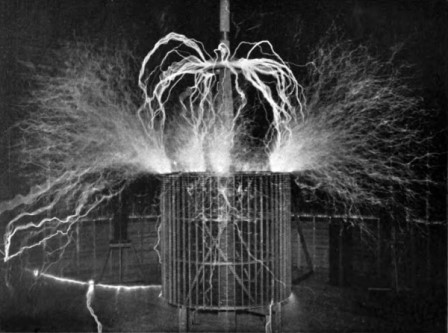
Übermann's lab contains a massive Tesla coil, Van de Graaff
generator, and an uranmaschine. A Tesla coil is a
resonant transformer invented by Serbian-American engineer
and inventor Nikola Tesla in 1891. A Van de Graaff generator
is an electrostatic generator named for American physicist
and inventor Robert Van de Graaff in 1929. Uranmaschine is
German for "uranium machine", a particle accelerator. |
 |
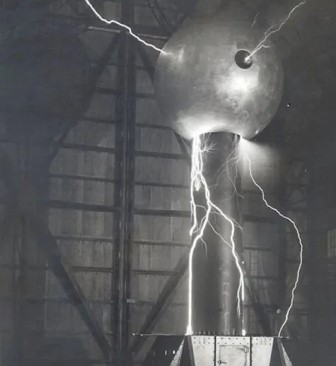 |
| Tesla coil |
Van de Graaff generator |
|
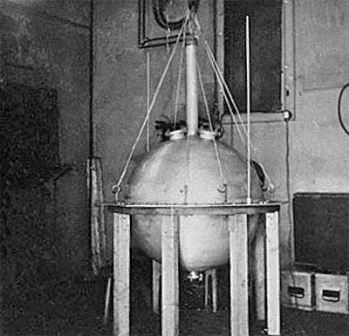 |
|
| Uranmaschine |
|
As Übermann observes the effect of the orichalcum beads in
the particle accelerator on page 82, he remarks in awe, "Das ist
wundervoll." This is German for "That's wonderful."
On page 83, Übermann cries out, "Himmel!" as he ducks
for cover from the chain reaction of destruction that takes place in
the lab as the orichalcum beads overcome the metal walls of the
particle accelerator.
Himmel
is German for "Heaven".
On page 85, all of the people mentioned in the audience for
Übermann's lecture are historical German physicists in the country's
Arbeitsgemeinschaft für Kernphysik (Working Group for
Nuclear Physics).
Übermann is said to have been one of the founders of the
Verein für Raumschiffahrt and was director of the Kummersdorf
Experimental Station at
Brandenburg. The
Verein für Raumschiffahrt
(Society for Space Travel) was a pre-WWII German amateur rocket
association in Germany that also included members from outside the
country. The
Kummersdorf Experimental Station was an estate south of Berlin
that hosted the weapons office of the German Army. Of course,
Übermann is a fictitious character, so did not hold these positions
in reality.
On page 86, Wunderwaffe and Überbombe are
German for "wonder weapon" and "superbomb".
CHAPTER 7: TIKAL
On page 88, the Pact of Steel agreement, ensuring cooperation
between Germany and Italy in the event of war, is an historical pact
between the two nations signed on May 22, 1939.
On page 91, the Petén Basin is an actual region of the Yucatan.
The text tells that it is over 12,000 square miles, but it is
actually over 19,000 square miles.
Indy and Sophia fly from the Azores to Guatemala, landing in
Santa Elena near the capital (of the Petén department) of Flores.
These are both actual cities.
Page 92 states that Indy had not been to Guatemala in over 10
years. This is meant to refer to his visit to Tikal in
The Seven Veils for the
London University expedition in 1926. But, he was also there briefly
in 1933 in
The Philosopher's Stone.
On page 92, Indy's party crosses Lake Petén Itzá. This is an
actual lake in the
Petén Basin and has almost 30 Maya sites around its
circumference.
Coming upon a swollen creek in the jungle too deep to cross on
foot, Indy chops loose the end of a vine for he and Sophia to swing
across. Sophia sarcastically remarks, "I don’t believe this. You
really want to play Tarzan right now?" Tarzan, of course, is the
world-renowned character created by Edgar Rice Burroughs in 1912, a
British boy who was lost in the African jungle and raised by apes.
He was known for swinging through the jungle on vines.
On page 94, Indy sardonically thinks of Sophie as the Princess of
Park Avenue. Park Avenue is a street in New York City well known for
its history of luxury, sophistication, and wealth.
Also on page 94, Indy points out an ixcanan plant with red
flowers and known as guardians of the forest. This is an actual
plant that grows in subtropical and tropical areas of the Americas,
species name Hamelia patens.
On page 95, Indy muses that the ruins of Tikal cover more than 50
square miles. This is roughly true. And the modern day
Tikal National
Park covers about 220 square miles.
Indy and Sophie find an ancient roadway in the jungle and Indy
believes it is a sacbe, a network of paved roadways
constructed by the Maya that spread across the Mayan civilization,
joining all the major ceremonial centers of the Mayan empire. This
is an accurate description of a sacbe
(white road), plural sacbeob.
On page 96, Sophie treks into a grove of kapok trees. These would
be of the Ceiba pentandra species, native to Central
America, northern South America, and the Caribbean and known for the
use of its fibre for stuffing and insulation.
Tikal was rediscovered in modern times by Ambrosio Tut in 1848,
just as Indy reflects on page 97.
Indy's musings that the ruined city of Tikal was originally
called Mutal and also known as "The Place of the Voices" is correct.
Indy's explanation of a chultun on page 98 is accurate.
CHAPTER 8: TOMB OF AN ATLANTEAN KING
Sternhart carries a
Winchester
rifle to hunt the jaguars that have been getting into his supplies.
On page 104, Sylvanus Morley (1883-1948) was an American
archaeologist and epigrapher who studied pre-Columbian Maya
civilization.
On page 104, Sternhart mentions the
British Museum.
The list of archeologists in Tikal and their accomplishments on
pages 104-105 is accurate.
Sternhart remarks that he foresees the day when Tikal will be a
thriving tourist destination like
Cairo.
On page 107, the Hindu elephant god Ganesh, Remover of Obstacles,
is an actual part of the Hindu pantheon, and elephants are, indeed,
mentioned in Plato's Critias.
On page 109, Sternhart mentions the Pre-Classic period of Maya
civilization, saying it goes back to 1800 BC. Most scholars suggest
the
Pre-Classic period to have existed from about 2000 BC to 250 AD.
Indy discovers script written into the moldy stone of the
corpse's alcove in the pyramid, resembling Sahidic. Sahidic is a
dialect of the Coptic language of Ancient Egypt.
With the help of Nur-Ab-Sal, Sophie reads the
stone script as, "Azatlán will live on, past fallen cities and wars
that overthrow the mighty empires of the earth, beyond civilizations
stomped into the dust of history, reborn in the dreams of our
descendants, and returned to its former glory. Time…is the seed of
the universe."
Azatlán is the ancestral home of the Aztec peoples, north of
Central Mexico. Historians have speculated that, if not
mythological, it may have been located in what is now northern
Mexico or the southwestern United States.
The last sentence of the quote is from the
Mahabharata, an epic text of Hinduism.
Sternhart unexpectedly gets the drop on Indy and Sophie with a
Walther P-38
pistol.
CHAPTER 9: TRAPPED!
On page 114, Indy thinks derisively of Ignatius Donnelly and a
book the man wrote that had influenced Sophia. Ignatius L. Donnelly
(1831-1901) was a Minnesota Congressman and writer on fringe
theories. His 1882 popular book Atlantis: The Antediluvian World
is likely the book Indy is thinking of here.
Trapped in the pyramid, Sophie remarks to Indy, "The Atlanteans
were a peaceful society. This isn't some booby-trapped temple in a
Republic serial." Republic was an American film studio from
1935-1967, known particularly for cliffhanger film serials,
including exotic adventure stories of exploration of lost,
booby-trapped ruins. The Republic Pictures name is now owned by
Paramount Pictures.
On page 121, Indy and Sophie come across an Atlantean elevator in
the pyramid and Indy jokes, "I thought Mr. Otis invented the
elevator!" He is referring to the
Otis Elevator Company,
founded by Elisha Otis in 1853. Though he did not invent the
elevator, he did invent the safety elevator, which would
automatically halt in the event of a hoisting rope failure. In the
computer game, the "Mr. Otis" comment is made by Sophia much later,
in the labyrinth under Knossos on the island of Crete.
On page 123, Guten Tag is German for "Good day".
CHAPTER 10: FORTUNE-TELLING
Page 129 reveals that the Barnett College newspaper is the
Barnett Bugle. One of its student reporters is Kathleen Marc.
Pages 130-131 mention the hard times of the Great War, the stock
market crash of '29, and the Great Depression. These refer to what we
now call World War I (1914-1918) and the
stock market crash that is often considered the beginning of the
Great Depression which lasted from 1929-1939.
On page 132, Indy mentions that the
Nazis had initially tracked down Sophia through an article in a
10-year old copy of National Archaeology. This is the
fictitious magazine glimpsed in an early portion of the game.
I found this passage of Indy's musings on page 132 amusing:
The last thing he wanted to do was
announce to the entire academic world that he was looking for
Atlantis. Sophia had destroyed her reputation for that very reason,
but Indy saw no benefit in tarnishing his already checkered past.
Besides, if his father found out that he was entertaining serious
notions of the fabled lost city, he would never hear the end of it.
On page 134, Indy and Sophia go to dinner at the Sophia Café.
Page 135 indicates that Indy drives a Plymouth. Plymouth was an
American automobile brand manufactured by Chrysler from 1928-2001.
Sophia tells Indy that in finishing school she was known as the
Cassandra of Commonwealth Avenue.
Commonwealth Avenue is a major street in Boston.
Cassandra was a priestess in Greek mythology who was cursed to tell
prophesies of the future but never to be believed.
Before entering the restaurant, Sophie
tells Indy her dress is a J. L. Hudson original costing more than
his yearly salary. This refers to the J. L. Hudson Department store, a high-end
chain that did business from 1881-2001.
As the pair enter the restaurant, the sonorous violin strains of
"Beyond the Sea" are said to be played over the soft clatter of
silverware and the murmur of the crowd. As far as I can find, the
only notable musical piece called
"Beyond the Sea" is a song originally written in 1945, so it
couldn't be playing here!
The "Fairfield" mentioned on page 135 is the fictitious town in
which Barnett College is located.
On page 138, kakavia is a Greek fish stew and ka'ak
is an Arab baked good, such as bread or pastries, in the shape of a
ring.
Page 138 states that Indy lives in a small brick house on Lincoln
Street, two blocks from the gently rolling hills of West Canada
Creek.
Canada Creek appears to be a fictitious watercourse.
Indy and Sophie study the Kircher map, which has an island
continent marked on it called Insula Atlantis. Athanasius
Kircher (1601–1680) was a German Jesuit scholar and polymath who
published works in many disciplines, including a map depicting the
alleged location of Atlantis.
CHAPTER 11: DESERT SANDS
On page 145 "Yaa jamila!" is Arabic for "Oh beautiful!"
Also on page 145, souk is another word for a bazarre.
On page 146, the Tassili Mountains are an actual mountain range
in Algeria.
Page 146 states that some researchers believed Carthage was a
replica of the city of Atlantis, while French archaeologist Félix
Berlioux declared that he had found the Lost City in the foothills
of the Moroccan Atlas range, between
Casablanca
and Agadir.
These are both actual theories of the 19th Century.
Carthage was an ancient port city of northern Africa, in what is
now Tunisia.
Indy marvels it could have been a page from The Arabian
Nights, as he and Sophia stroll through the bustling Casbah,
the original walled city founded on the former Roman settlement of
Icosium. Icosium was a Phoenician and Punic settlement in Algeria
that became a Roman colony. The modern day city of Algiers is built
upon it.
The Arabian Nights refers
to the Arabic
story collection One
Thousand and One Nights (also
known as Arabian
Nights in the
Western world), believed to have originated around the 8th Century
AD.
On page 147, Indy spies the twin domes of the Ketchaoua Mosque.
(Image from
Wikipedia.)

The Mamluke era mentioned on page 147 lasted from 1250-1517 in
Egypt and Syria.
The Sultan Hassan Mosque in Cairo and the Djemaa-Djedid Mosque in
Algiers also mentioned on page 147 are both real world mosques.
On page 148, "Salaam alaykum," is a traditional Arabic
greeting meaning "Peace be upon you," and the vendor's return
greeting to Indy of "Wa alaykum us-salaam," means "And upon
you be peace."
On page 151, Omar shows Sophie a comb in his booth that he claims
once belonged to Mata Hari and a white cane touched by Queen
Victoria. Mata Hari was an exotic dancer in France who was convicted
and executed as a spy for Germany in WWI. Indy met and had an affair
with her in Paris in
1916 in "The Mata Hari Affair".
Queen Victoria was the ruler of
the United Kingdom from 1837-1901.
Omar's use of "Al-Almaan"
on page 151
seems to be a caustic use of "noble and wise man" in
reference to Nazis.
On the map shown to he and Sophie by Omar of the
Nazis' dig site in the Atlas Mountains
on page 152, Indy sees that once again
"X" marks the spot, despite his teachings. Indy has told his
students on more than one occasion (notably in
"Tomb
of the Gods" Part 2 and
The Last Crusade) that "X"
never marks the spot.
Indy's parting utterance to Omar as he
and Sophie leave the vendor's booth is "Waalidatuka
shar mutah." This means "Your parents are evil."