Tenochtitlan (in Indy's dream only)
Aztecs (in Indy's dream only)
Kate
Jerry Travis
Barnett College students
Samuel Corn/Colonel Klaus Gerhard Kerner
Dr. Jastro (mentioned only)
Atlanteans (mentioned only)
Madame Sophia devotees
Nur-Ab-Sal
Dr. Hans Übermann
Roger Fontane
Miss McMurphy
Kerner's thugs
German soldiers
Nuremberg citizens
German colonel
Didja Notice?
In Indy's dream on page 1, a decorated Mexican Indian figure
(Nur-Ab-Sal) declares himself to be Tenochtitlan, god of war. Tenochtitlan was
actually the name of an Aztec city-state that existed in what is now
Mexico for hundreds of years. The city was associated with the Aztec
god of war, Huitzilopochtli.
Page 2 indicates that Indy lives in the Barnett College faculty
quarters at this time.
The character of Samuel Corn in the comic is the same as Mr.
Smith (actually German colonel Klaus Kerner) in the game.
"Corn" identifies one of Indy's arrowheads as 18th Century
Iroquois.
Iroquois or Haudenosaunee (Native name) was a confederacy of five
indigenous peoples in northeast North America that existed when
French and English settlers arrived on the continent. In 1722, a
sixth people joined.
On page 8, a shelving unit in
Barnett's archeology department storage room is labeled "Moctezuma"
and "Aztec".
Moctezuma was an Aztec emperor in the 15th Century AD. The Aztecs
were an ethnic group of Mexico in the 14th-16th Centuries, known for
the Aztec Empire of the time.
In panel 5 of page 8, a crate is
labeled "Anno 1913". Anno is Latin for "year".
Indy remarks to Marcus that he considered Dr. Jastro to be sloppy
and a braggart.
On page 9, Indy finds the horned statue in the storage room and
the tag on it reveals it was found not far from Reykjavik and dated
to 1500 B.C.
Reykjavik is the capital of Iceland.
When "Corn" steps in on Indy and Marcus in the storage room at
gunpoint, Indy clues Marcus in to dive to the side by commenting,
"This is just like that time in Algiers! Right, Marcus?"
Algiers is the capital of Algeria.
On pages 10-11, "Corn" says, "Verteufel!", "Schnell,
schnell! Fahren wir!", "Himmel! Jetzt!",
"Verdammt!", and "Er hört nicht auf!" These are German
for "Damn it!", "Quick, quick! Let's go!", "Heavens! Now!", "Damn!",
and "He won't stop!"
|
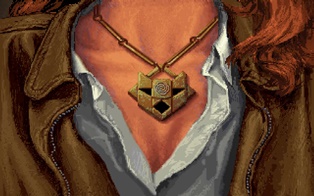
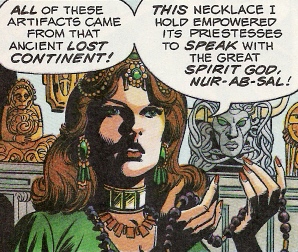
The necklace that puts Sophia in touch with Nur-Ab-Sal looks
much different here in the comic than it does in the
computer game. |
 |
 |
| Necklace in the computer game |
Necklace in the comic |
On page 19, Indy thinks of Sophia as fleecing suckers like some
three-card monte dealer.
Three-card monte is a con game played on the street where a dealer
uses sleight of hand to trick players into betting they can find the
"money card" among three face-down cards, but the operator uses
misdirection, speed, and shills among the spectators to ensure the
player loses each time.
On page 24, Kerner says, "Danke sehr!" This is German
for "Thank you very much!"
Page 25 opens with Dr. Übermann and a German colonel in
Nuremberg, Germany, examining the artifacts recovered by Kerner
in the U.S.
Übermann remarks that he believes the artifacts are clues to a
very powerful energy source and the colonel asks, "As powerful as
Hahn and Strassmann's atomic reaction?" Fritz Strassmann (1902–1980)
and Otto Hahn (1879-1968) were German chemists who identified the
phenomenon of nuclear fission, after bombarding uranium with
neutrons to from the element barium.
A bank of equipment with gauges on it and the word "BOSCH" is
seen in the background in panel 3 of page 25.
Bosch is a
German engineering and technology company founded in 1886.
Dr. Übermann is depicted here with a Hitler-style mustache, known
as a toothbrush mustache.
On page 26, Kerner exclaims, "Lieber gott!" as he
watches Übermann's demonstration of the Atlantean device. This is
German for "Dear God!"
 |
Notes from the
computer game
Indiana Jones and the Fate of Atlantis
Video game
Story by Hal Barwood & Noah
Falstein
Developed and published by LucasArts
1992
|
Characters appearing or mentioned in the computer game,
not in the comic book
Fritz
Biff
Lenny (projectionist)
Harry D. Ward (journalist, name seen in NY newspaper only)
Bjorn Heimdall
Didja Notice?
The game opens with Indy
searching what is later said to be the attic of Caswell Hall at
Barnett College. But why does he swing in through a closed window on
his bullwhip, shattering the glass?? Can't he just walk in? (The
novelization explains that the passageway to this long-forgotten
storage room had been walled up in the 1920s during renovations. In
the novel, Smith helps Indy uncover the lost passage and Indy enters
through it rather than swinging in through the window.)
Barnett College is the school at which Indy is seen teaching in The
Last Crusade. It is a fictitious institution.
In the attic, Indy sees a statue of a primitive warrior and
comments, "Poor Marcus...he thought this was a Masai warrior." The
Masai are an ethnic group in East Africa,
known as fearsome warriors.
Indy also finds a stone carving of Shiva, a medieval gargoyle, a
copy of an Egyptian statue of Horus, a chest that may have belonged
to Columbus, and a "peculiar statue". Shiva is the Hindu god of
destruction and transformation. Gargoyles are
mythological monsters, statues of which were once believed to
frighten away evil spirits.
In ancient Egypt, Horus was one of the chief gods and was depicted
as having a falcon's head. Christopher Columbus (~1450-1506) was an
Italian explorer who is credited with opening up the New World for
Spain in 1492. Later in the game, Indy concludes the "peculiar
statue" is a crude copy of a Persian idol; Persia is the ancient
name of modern day Iran.
In the lower portion of the attic,
Indy finds textiles from the Shawmut collection and a totem pole
possibly carved by Potlatch Indians. "Shawmut" is a term for a
certain region near
Boston, Massachusetts, probably derived from the Algonquian
language. "Potlatch" refers to a gift-giving ceremony among a number
of the indigenous peoples of the Pacific Northwest of North America.
In another level
of the school library, Indy finds cheap copies of a Siamese idol in
the form of a cat. "Siam" was the name of Thailand before 1939.
Siamese cats are a breed of domestic cat originally native to Siam,
now popular in Western nations.
After taking the horned idol and its
contents from Indy and Marcus at gunpoint, Mr. Smith turns to the
window and asks himself, "Wo ist Fritz?" This is German for
"Where is Fritz?"
Indy and Marcus find Smith's passport in his
coat, revealing his real name to be Klaus Kerner, a member of the
Third Reich.
The Third Reich refers to the German state under the Nazi Party of
dictator Adolf Hitler.
The comic book adaptation reveals he is a colonel in the
SS (Schutzstaffel, "Protection Squadron"), the Nazi secret police.
Smith's coat has a copy of National Archeology magazine
stuffed into a pocket. This is a fictitious magazine.
Indy says that his position as field supervisor for the Jastro
Expedition in Iceland was his first real job. This would have been
around November 1929 according to Indiana Jones: The Ultimate
Guide. According to the comic book adaptation, the expedition
was sponsored by Barnett College. By "first real job", Indy must
mean his first real job in archeology, for he had a number of
non-archeology jobs previously.
Here in the game, Marcus does not seem to
know who Sophia is. But he is well aware of her in the earlier story
in the Indiana Jones chronology,
Thunder in the Orient,
with Sophia telling Indy in Nepal that Marcus should have informed
him that it was she who asked for Indy to join the expedition.
Here in the game, Indy tells Marcus that Sophia was a spoiled
rich kid from Boston. But in the comic book adaptation, Sophia says
she is from
Philadelphia, Pennsylvania.
The novelization refers to the stagehand Indy speaks to while
watching Sophia on stage as Lenny.
In her lecture on stage, Sophia talks of the alleged history of
the fabled city of Atlantis, written about by Plato. Plato was a
philosopher in ancient Greece who founded the first institution of
higher learning in the Western world,
the Academy, in
Athens. Plato
wrote of Atlantis as an advanced island city of far gone history in
his Timaeus and Critias as part of an allegory on
the hubris of nations which, after an ill-fated military campaign
against Greece, lost favor with the gods and was sunk into the
ocean.
Sophia speaks of the Great Spirit who guides her thoughts,
calling it Nur-Ab-Sal.
Though "Great Spirit" is a term used by numerous cultures around the
world throughout history, Nur-Ab-Sal is a fictitious Atlantean
god-king made up for this story.
During Sophia's lecture, Indy gives the stagehand the latest
newspaper and the man is excited to flip through it to see if the
Dodgers won. At this time, the
Dodgers
were the Major League Baseball team based in Brooklyn, New York (now
based in Los Angeles since 1958).
Brooklyn
is one of the five boroughs of
New York City.
As Sophia mentions to Indy, orichalcum is a mythological metal
second only to gold in value and associated with Atlantis by Plato.
However, an actual metal labeled as orichalcum was finally found in
2015-16 in an ancient sunken shipwreck off the coast of Gela, Sicily
and analysis found it was composed of mostly copper, some zinc, and
small percentages of nickel, lead, and iron. It is obviously not a
mythical fuel as seen in this story.
Sophia claims to hear from
Nur-Ab-Sal in her mind, telling her to find the Lost Dialogue of
Plato. Historians are certain that there are many dialogues of
Plato lost to history, but no definitive single one referred to as
the Lost
Dialogue of Plato.
 |
Notes from the computer
game novelization by Dale Dassel
(pages 1-32 roughly cover the
events of
Indiana Jones and the Fate of
Atlantis #1) |
Summary of this portion of the
novelization
Indiana Jones is forced by a Nazi
agent, Klaus Kerner, to crawl through a hidden tunnel beneath
Barnett College to retrieve a mysterious horned bronze idol, while
Marcus Brody is held at gunpoint. Indy finds the idol in a secret,
long-forgotten treasure vault filled with uncatalogued artifacts.
During the escape, Indy and Marcus briefly overpower Kerner, but the
Nazi ultimately escapes with the idol.
Investigating Kerner’s motives,
Indy discovers a link to his former assistant
from an earlier Icelandic expedition, Sophia Hapgood, now a
flamboyant New York psychic obsessed with Atlantis. Indy rushes to
warn her, interrupting her sold-out stage show at the Imperial
Theater just as Nazi agents attempt to seize her. A chaotic brawl
erupts onstage, exposing Sophia’s theatrical tricks, but Indy and
Sophia manage to fend off the attackers.
Afterward, Sophia’s apartment is
found ransacked—Kerner has already searched for Atlantean artifacts.
Sophia reveals she still possesses a powerful bronze pendant from
the aforementioned Icelandic expedition. When activated with a rare metal
called orichalcum, the pendant produces an eerie, seemingly
supernatural manifestation, convincing Indy that the artifact may
hold real power. Sophia claims the relic is
connected to Atlantis and a lost Platonic text, the Hermocrates,
which could unlock immense technological energy. Though skeptical,
Indy realizes the Nazis’ interest poses a global threat. Reluctantly
but resolutely, he agrees to help Sophia return to Iceland to
investigate further.
Meanwhile, Kerner orders his
remaining agents to follow Indy and Sophia, retrieve the necklace,
and kill Indy if necessary—setting the stage for a race against the
Nazis to uncover the secrets of Atlantis.
Characters appearing or mentioned in this novel, not in
the video game
Barnett College janitor
Imperial Theater ushers
Henry Jones, Sr. (mentioned only)
Marion Ravenwood
(mentioned only)
Karl Sankt
Torsten Fleischer
Didja Know?
This book is a fan-written novelization combining elements of
the game and comic book and was released online for free from
2010-2013. This piece
by Dale Dassel is generally held in high regard for its quality
of writing and research.
Didja Notice?
The novel opens with a quote from Colonel P.H. Fawcett from his
book Lost Trails, Lost Cities.
Colonel Percy Fawcett was a British explorer and archaeologist who
disappeared in the Brazilian jungle with his son Jack and Raleigh
Rimell in search of the lost city of Z in 1925. The Colonel Fawcett
mystery plays a large part in the Indiana Jones novel
The Seven Veils.
Lost Trails, Lost Cities is a
posthumous book put together by Fawcett's son Brian Fawcett in 1953.
PROLOGUE
Page 7 states that
Marcus, in his mid-sixties, was no age for a man of his disposition
to be gallivanting around the world after artifacts. Yet, Indy will
do that at least into his 70th year (The Dial of Destiny).
Page 14 says that Indy has not seen or
spoken to Sophia since the Jastro expedition in 1929, but, again,
she shares an adventure with him in 1938 in
Thunder in the Orient.
The novel places these events in June 1939 instead of May,
perhaps because
The Lost Journal of Indiana Jones indicates June
for this adventure. (Page 216 of the novel has Sophie saying it is
June 22, specifically, the day she and Indy arrive at Knossos.)
Page 16 describes Sophie's performance venue as Imperial Theater on
West 45th Street. This is an
actual theater at 249 West 45th Street the in midtown Manhattan
borough of New York City.
On page 17, at the utility entrance of the theater, Indy is
confronted by a heavy bouncer who looks like a Cro-Magnon in a
tuxedo.
Cro-Magnons were the first modern-type early humans to settle in
Europe; they generally had broader faces, more prominent brow
ridges, and bigger teeth than typical humans today.
On page 22, Indy asks the Nazis he's fighting, "Habt ihr
Typen vergessen, wie man spricht?" This is German for "Have you
guys forgotten how to speak?"
On page 23, Indy points at the pile of unconscious foes on the
stage and tells the audience in the seats, "No tickets." This is a
callback to the same line made by him in
The Last Crusade
after tossing a Nazi out the window of a grounded zeppelin's passenger
compartment.
CHAPTER 2: DEPARTURE
The Ahnenerbe mentioned on page 26 was
a branch of the Nazi SS dealing with research on the history of the
Aryan race. Indy previously encountered members of the Ahnenerbe
in the "Tomb
of the Gods" storyline, and possibly other Nazi
treasure seekers he'd encountered had been working for the
organization as well.
On page 28, Hermocrates (5th Century
BC) was a Syracusan general during the Athenians' Sicilian
Expedition of the Peloponnesian War. The book called
Hermocrates is a hypothetically believed to exist
dialogue, the third part of Plato's trilogy along with Timaeus
and Critias.
Page 29 has Indy reflecting that he already spent most of his
sabbatical leave from Barnett on the Grail quest (in
The Last Crusade).
On page 29, the Wehrmacht is the name for the unified
German armed forces from 1935-1945 during the Nazi reign.
On page 31, Sophia places a call to Pangaeascape Travel Agency.
This is a fictitious business.
|
The only outward sign of Kerner's
fealty to the Nazi party on his expensive suit is the
Reichsadler pin. This is a heraldic eagle symbol that
was used by the Nazis. |
 |
On page 31, Kerner threatens Karl to spend the rest of his career
on the corpse disposal squad at Dachau.
Dachau was
one of the first Nazi concentration camps in Germany, built in March
1933.
On page 32, Karl and Torsten are
referred to as Abwehr agents. The
Abwehr was the German military-intelligence service
from 1920-1944.
Also on page 32, Jawohl is German for "Yes, of course."
Memorable Dialog
the coldest year of my life.mp3
think big like the Americans.mp3
Back to Indiana Jones Episode
Studies