 |
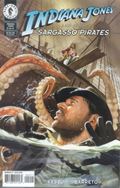
Indiana Jones
"Sea of Troubles"
Indiana Jones and the Sargasso
Pirates #2
Dark
Horse Comics
Writer and pencil breakdowns: Karl Kesel
Finished art: Eduardo Barreto
Lettering: Pat Brousseau
Coloring: Bernie Mireault
Cover: Alex Ross
January 1996
|
Indy and crew find themselves trapped in a
graveyard of ships in the middle of the Sargasso Sea.
Notes from the Indiana Jones chronology
Indiana Jones and the Sargasso Pirates is a 4-issue
mini-series published by Dark Horse Comics in 1995-96. The story
takes place shortly after the start of WWII, which started on
September 1,
1939.
Notes from
The Lost Journal of Indiana Jones
The Lost Journal of Indiana Jones is a 2008 publication
that
purports to be Indy's journal as seen throughout The
Young Indiana Chronicles
TV series
and the big screen Indiana
Jones movies. The publication is also annotated with notes
from a functionary of the
Federal Security
Service (FSB) of the Russian Federation, the successor
agency of the Soviet Union's KGB security agency. The KGB relieved Indy of his
journal in 1957 during the events of Indiana
Jones and the Kingdom of the Crystal Skull.
The notations imply the journal was released to other
governments by the FSB in the early 21st Century. However, some
bookend segments of The
Young Indiana Chronicles
depict Old Indy still in
possession of the journal in 1992. The discrepancy has never
been resolved.
The journal as published does not mention the events of this
mini-series,
going from entries about the events of
The Fate of Atlantis in
May 1939 to Indy's time working with Colonel George "Mac" McHale
during 1944. A five year gap seemingly left un-journaled.
Characters appearing or mentioned in this issue
Cairo
Indiana Jones
Bill Lawton
New Jersey Jones
Sargasso pirates
Segar
Sea Witch
bosun
Dr. Wilson (mentioned only)
Didja Notice?
When Cairo learns the lifeboat carrying herself, Indy,
Lawton, and New Jersey has drifted into the fabled Sargasso
Sea, she exclaims, "What's next, Jones? Never-Never Land?"
Never Never Land is the island where Peter Pan and other
mythical beings live in the Peter Pan works of J. M. Barrie.
On page 6, Indy's companions dine on eel, which New Jersey
finds tastes like chicken. Eel meat flavor has been compared
to that of chicken. Indy himself eats seaweed, finding the
eels to be too close to snakes to stomach.
On page 10, the pirate quartermaster calls his men "mein
seeraubers". This is German for "my pirates".
The name of the pirate's quartermaster, Segar, is likely a
nod to E.C. Segar (1894-1938), the creator of Popeye the
Sailor in the comic strip Thimble Theater. In fact,
Segar here is missing one eye, just as is Popeye.
Come to it, the character of New Jersey Jones is likely
based on the Thimble Theater character J.
Wellington Wimpy. Both characters are cowardly scam artists,
overweight, and wear bowler hats. In addition, in "Blood on
the Water", New Jersey remarks, "Let's you and him fight," a
phrase originated with the Wimpy character.
On page 11, Segar refers to New Jersey as fettmops.
This is German for "fat pug".
The pirate captain, known only as the Sea Witch, was
inspired, according to writer Karl Kesel, by the Dragon Lady
from Milton Caniff's Terry and the Pirates comic strip and
the Sea Hag, one of Popeye's nemeses in the Thimble
Theater comic strip.
On page 12, Segar refers to Cairo as fraulein. This
is German for "miss".
On page 14, Segar tells the Sea Witch the castaways' vessel
was a rettungsboot and he claims a zeltleinwand
for himself to collect water. These are German terms for a
"lifeboat" and a "tent canvas", respectively.
On page 15, New Jersey tries to convince the Sea Witch he's
from the sea himself, throwing in the malapropisms, "bring
the port to starboard" and "scuttle the bilge". "Port" and
"starboard" are simply nautical terms for the left and right
sides of a vessel when aboard and facing the bow. The bilge
is the lowest portion of the vessel, where excess water
collects and is eventually pumped or bailed out. "Scuttle"
means "to sink" a vessel, so when New Jersey says "scuttle
the bilge", he's unknowingly saying to sink the ship.
The Sea Hag tells her crew to prepare the rumfustian.
Rumfustian is a British alcoholic beverage known from the
17th Century.
When the Sea Witch brings the "kraken" up from the depths by
blowing through a sea shell horn, Indy is shaken by the
thing and its tentacles, but remarks that he's seen bigger.
In several earlier adventures, Indy faced giant octopi and
krakens in Journey
to the Underworld, The
Shrine of the Sea Devil, and The
Emperor's Tomb.
On page 21, Segar says, "Guten
tag, Indiana! How are you doing?" and Indy responds, "Es
geht mir gut, Segar." Guten tag is German for
"good day" and "Es geht mir gut" is "I'm doing
well."
Indy recognizes the insignia on Segar's shirt as that of a
U-boat captain. Segar acknowledges the truth of it and says
his boat was sunk by a dreadnought and he and his crew
drifted into the Sargasso in 1916. Segar being German, this
would mean he was the captain of a German U-boat during WWI
(or the Great War as it was known at the time).
On page 22, ja and nein are German for
"yes" and "no".
When Indy starts talking with Cairo about the historic
treasures supposedly held aboard the Freedom, she
remarks sarcastically, "Sure. Treasure galore. We're all
rich as Rockefeller."
This is a reference to the Rockefeller family, made rich by
John D. Rockefeller, Sr. (1839–1937), founder of the
Standard Oil Company.
On page 24, Cairo
sultrily asks a few assembled crew members what there is to
do around there, like catch a flick at the Bijou or cut a
rug with Benny Goodman. In the first half of the 1900s,
"Bijou" (French for "jewel") was a common name for theaters
in the U.S. Benny Goodman (1909–1986) was an American jazz
clarinetist and bandleader, known as the "King of Swing".
She also asks if any of the sailors know "The St.
Louis Blues". This is a 1914 jazz song composed by W.C.
Handy.
Making his way through the galleon in search of the treasure
room, Indy wishes he'd paid more attention to Dr. Wilson's
paper on galleon construction. "Wilson" may be a name check
to Lucy Autrey Wilson, president of Lucas Licensing at the
time.
In the last panel of page 24, Indy makes his way to the
orlop deck of the galleon. This is the lowest deck in a ship
above the hold.
Back to Indiana Jones Episode
Studies
