 |
Indiana Jones
"The Search for Abner, Chapter 2:
The City of Yesterday's Forever"
The Further Adventures of
Indiana Jones
#18
Marvel Comics
Plot/Script: David Michelinie
Pencils: Herb Trimpe
Inks: Colletta, Bulanadi, Chan
Letters: Joe Rosen
Colors: Robb Carosella
Cover: Herb Trimpe (pencils),
Jack Abel (inks), Rob Carosella
(colors)
June 1984
|
Who is the man in the gold mask?
Notes from the Indiana Jones chronology
This story takes place immediately after the events of
"The Grecian Earn", in 1936.
Didja Know?
The "The Search for Abner" storyline of
issues 17 and 18 of The Further Adventures of
Indiana Jones
also served as the source for the "Nepal Nightmare Adventure
Pack" of the Adventures of Indiana Jones role-playing
game in 1984.
Notes from
The Lost Journal of Indiana Jones
The Lost Journal of Indiana Jones is a 2008 publication
that
purports to be Indy's journal as seen throughout The
Young Indiana Chronicles
TV series
and the big screen Indiana
Jones movies. The publication is also annotated with notes
from a functionary of the
Federal Security
Service (FSB) of the Russian Federation, the successor
agency of the Soviet Union's KGB security agency. The KGB relieved Indy of his
journal in 1957 during the events of Indiana
Jones and the Kingdom of the Crystal Skull.
The notations imply the journal was released to other
governments by the FSB in the early 21st Century. However, some
bookend segments of The
Young Indiana Chronicles
depict Old Indy still in
possession of the journal in 1992. The discrepancy has never
been resolved.
The journal as published does not mention the events of this
issue, going from the end of
Raiders of the Lost Ark
in 1936 to
Indy's recovery of the Cross of Coronado in 1938 in The Last
Crusade.
Characters appearing or mentioned in this issue
Indiana Jones
Marion Ravenwood
Abner Ravenwood (?)
Marcus Brody
minotaur
(in flashback only)
New Dorians (mentioned only)
Bill Kershaw (mentioned only)
Ian McIver
Andre Lafonte
Yeti
Ra-Lundins
Chen Sha
Yun Chu
Nazis
(mentioned only)
Mongols
Sherpas
Didja Notice?
Page 4 quickly retells the events of
"The Grecian Earn".
On page 5, a Ra-Lundin man speaks the words "Waneenjiko!
Pala-hoi!" to Indy. According to Google Translate, this
appears to be Hawaiian for "I love you! Back again!"
Entering the hidden, domed city of Ra-Lundi, Indy reflects
that it's as warm inside as Chicago in May.
Chicago
tends to average in the high 60's to lower '70's in May.
Indy lived in Chicago to attend school at the University of
Chicago from 1919-1922 (and also, for a short time, when he was
14, according to
The Peril at Delphi).
On page 9, Marion awakens Indy, telling him, "It's the early
bird catches the artifact, y'know." This is a play on the
English idiom "the early bird catches the worm", which
originated in a 1605 book of proverbs (Remaines
Concerning Britain) by William Camden.
On page 10, Indy awakens and exclaims Marion's name,
surprised and delighted to see her still alive after her
fall from the mountain. Marion responds to him, "Good thing
you remembered my name, Jones, if you'da called me
'Alice'--I'd have knocked you back to dreamland myself!"
This may be a play by writer Michelinie on Alice in
Wonderland, or on the oft-used
phrase by the character of Ralph Kramden on the 1955-66
American television sitcom The Honeymooners, where
Ralph would tell his wife, Alice, in mock-seriousness when
he was upset with her that he would "knock her to the moon."
The F'han tal that provides heat, energy, healing,
and long life to the inhabitants of Ra-Lundi turns out to be
a meteorite worshipped by the Ra-Lundins. Indy encountered
another sacred meteorite when he was a youth in, well,
The Sacred Meteorite.
On page 16, Lafonte uses both monsieur and
m'sieur, the French word for "sir". He also says
"Mon dieu!", French for "My God!"
On page 21, Lafonte says "mon ami" and "Ma
foi!" These are French for "my friend" and "My faith!"
On page 22, Indy is wearing square eyeglasses instead of the
round style lenses he is usually seen in.
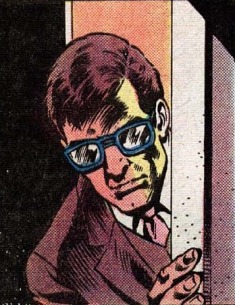
The end of this issue sets up a new story where the Arnhem
Ring recovered by Indy in "Blood and Sand" and placed on
display in the National Museum in "Demons" is found to have
been a forgery. But the story that follows in
The Further Adventures of
Indiana Jones
#19 ("Dragon by the Tail") has
nothing to do with it, and does not even mention it. This is
because that issue was a fill-in, with the Arnhem Ring
follow-up then beginning in issue 20 ("The Cuban
Connection"). For this reason, the PopApostle chronology has
issue 19 taking place after issue 22, the completion of the
three-part Arnhem Ring story.
Unanswered Questions
Was the white man behind the mask in Ra-Lundi actually Abner
Ravenwood? If so, why does he not acknowledge Marion and
Indy's presence? He does mumble Marion's name at one point
after Marion and the student leave the chamber, but he
could have simply been repeating the name she told him as
she tried to get a response from him. Also, recall the Chen
Sha said that a number of foreign men had stumbled across
Ra-Lundi in the past and been trapped there by the eternal
curse of the F'han tal, so the masked man could be
any white man.
Why the mask? Why was it sealed so it could not be removed?
It's convenient for the story so we don't get an answer as
to who the man is, but why would the Ra-Lundins find it
necessary to do that to the man?
Back to Indiana Jones Episode
Studies
